Browse the guide
Reference
Architecture
Azure infrastructure and deployment architecture for the Octo E-Shop platform.
Infrastructure and deployment architecture for the Octo E-Shop platform on Microsoft Azure.
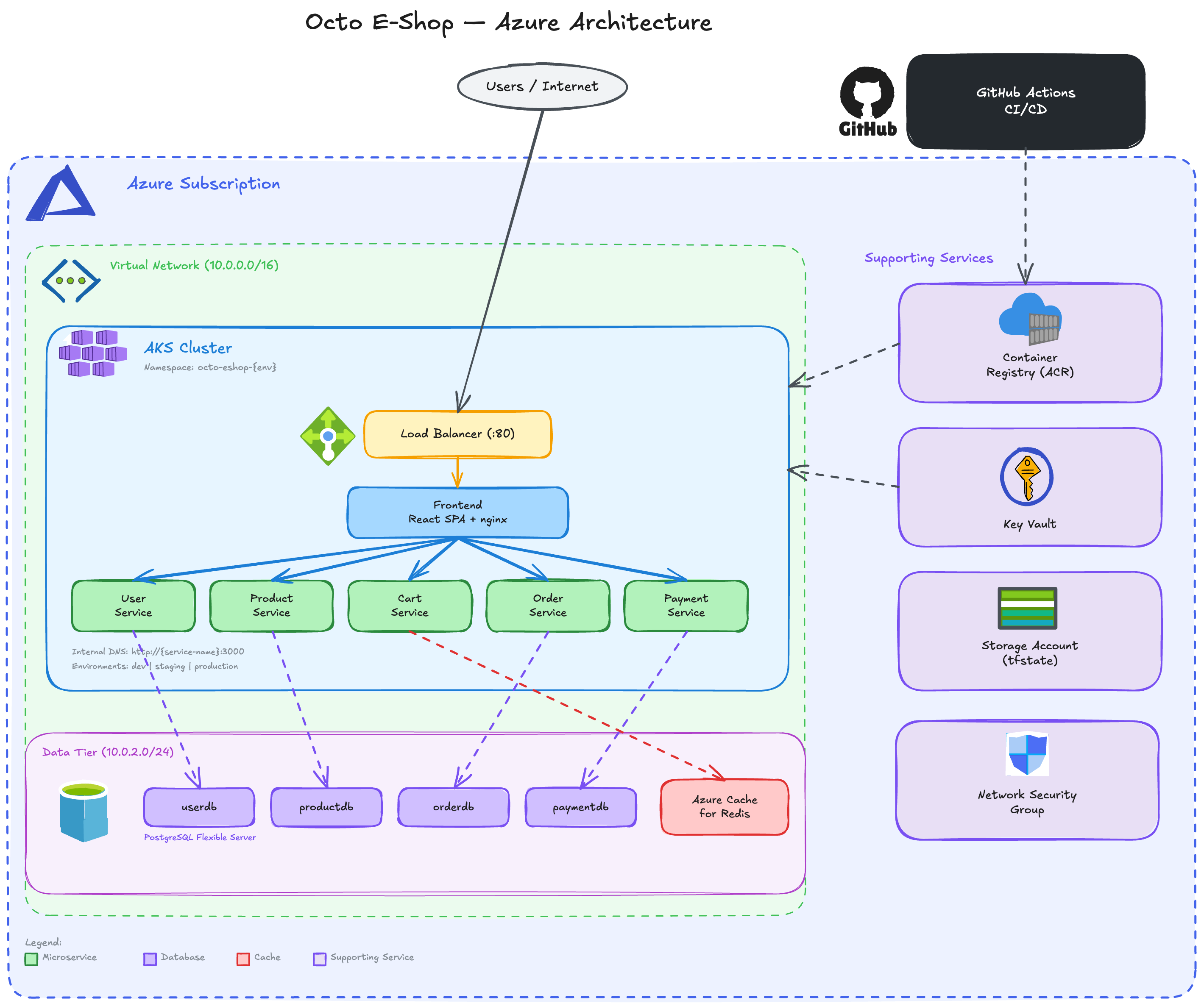
Overview
The Octo E-Shop platform runs on Azure Kubernetes Service (AKS) with a full suite of managed Azure services. Infrastructure is provisioned via Terraform and deployed across three environments: dev, staging, and production.
Azure Services
| Service | Purpose |
|---|---|
| Azure Kubernetes Service (AKS) | Container orchestration for all microservices |
| Azure Container Registry (ACR) | Private Docker image registry |
| Azure Database for PostgreSQL | Managed databases for user, product, and order services |
| Azure Cache for Redis | Session and cart data store |
| Azure Service Bus | Asynchronous messaging between services |
| Azure Key Vault | Secrets and certificate management |
| Azure Storage Account | Terraform state backend and static assets |
| Azure Log Analytics & Application Insights | Monitoring, logging, and diagnostics |
| Network Security Groups (NSG) | Network-level access control |
| Azure Load Balancer | Public ingress for the frontend |
Network Architecture
Each environment is deployed into its own Virtual Network (VNet) with dedicated subnets:
| Subnet | Dev | Staging | Production | Purpose |
|---|---|---|---|---|
| AKS Subnet | 10.0.1.0/24 |
10.10.1.0/24 |
10.20.1.0/24 |
Kubernetes node pool |
| Database Subnet | 10.0.2.0/24 |
10.10.2.0/24 |
10.20.2.0/24 |
PostgreSQL flexible servers (delegated) |
| Redis Subnet | 10.0.3.0/24 |
10.10.3.0/24 |
10.20.3.0/24 |
Azure Cache for Redis |
Network Policies (Kubernetes-level) restrict pod-to-pod communication and egress to database subnets. NSG rules control network-level access at the Azure layer.
Environment Sizing
| Resource | Dev | Staging | Production |
|---|---|---|---|
| AKS Nodes | 1 × Standard_D2s_v3 | 2 × Standard_D2s_v3 | 3 × Standard_D4s_v3 |
| PostgreSQL | B_Standard_B1ms | B_Standard_B1ms | GP_Standard_D4s_v3 (Zone Redundant HA) |
| Redis | Basic/C0 | Basic/C0 | Premium/P1 |
| ACR | Basic | Standard | Premium |
Infrastructure as Code
All infrastructure is managed with Terraform using a modular structure:
infrastructure/terraform/├── modules/│ ├── aks/ # Kubernetes cluster│ ├── acr/ # Container registry│ ├── postgresql/ # Database servers│ ├── redis/ # Cache instances│ ├── networking/ # VNet, subnets, NSGs│ ├── keyvault/ # Secrets management│ ├── servicebus/ # Message bus│ ├── storage/ # Storage accounts│ └── monitoring/ # Log Analytics + App Insights└── environments/ ├── dev/ ├── staging/ └── production/State is stored remotely in Azure Storage with Azure AD authentication.
Bootstrap
The Terraform state backend and Azure service principal are created by a one-time bootstrap script:
./scripts/bootstrap-backend.sh --subscription <sub-id> --repo <owner/repo>Provisioning
# Plan changes (safe — no modifications)gh workflow run infrastructure.yml -f environment=dev -f action=plan
# Apply after reviewinggh workflow run infrastructure.yml -f environment=dev -f action=apply
Cluster Add-Ons
After Terraform provisions the AKS cluster, the cluster-setup.yml workflow installs:
| Component | Purpose |
|---|---|
| ingress-nginx | Kubernetes Ingress controller for HTTP routing |
| External Secrets Operator | Syncs secrets from Azure Key Vault to Kubernetes secrets |
| ClusterSecretStore | Connects ESO to Azure Key Vault via workload identity |
| Managed Identity + Fed Cred | Enables passwordless authentication from ESO to Key Vault |
Security
- Secrets: Stored in Azure Key Vault, synced to GitHub Environment secrets and Kubernetes secrets
- Network: NSG rules + Kubernetes NetworkPolicies restrict traffic per environment
- Registry: ACR credentials automatically synced to GitHub secrets
- Authentication: Azure service principal with RBAC, AKS workload identity for Key Vault
- Scanning: Trivy container vulnerability scanning in CI pipeline